Dr. Dad
What does a pediatrician do when their own kids are sick?
I drafted this post weeks ago, but finished it tonight after spending the day at home with Rogue Three, who is sick (not seriously ill), so the timing couldn’t be better.
Many people have skills they develop for work that they end up using outside of their job. Some of these skills may be mundane, some may be difficult to master, and some may be only tangentially related to their work.
Mechanics are probably asked by family and friends to help all the time with cars making strange noises. Lawyers are asked by to help fix speeding tickets. Accountants are asked if the cost of hot water from a shower can be tax-deductible. Maybe you don’t realize it, but you probably have a skill you developed for work that you now apply in other situations, and maybe you do not always apply it willingly.
Physicians are no different, and may be the best example of this phenomenon. We are routinely asked by friends, family, neighbors, and sometimes strangers, for medical advice. Often on topics we know little about.
Asking Doctors for Advice
Often it’s a text or a phone call — a family member asking what to do when Johnny has a fever or if a laceration needs stitches.
Occasionally it’s at home – your adult neighbor fell and hit their head and the spouse wants to know if they need to go to the ER.
Or it happens AT work – a co-worker wants your opinion on joint pain, or a parent wants you to look at their rash while you are examining the child they brought to the ER and who is the patient.*
Sign up to receive email notifications of posts. Follow me on X, Facebook, or Instagram for entertainment and updates of new posts. Feel free to email me with comments, questions, or to ask about site sponsorship or public speaking.
*These are only a few of the things that have happened to me.
Recently while taking care of a child in the ER at ~2am, a father asked me to look at his own rash to see if he should be seen as a patient in the adult ER next door (I work in a pediatric ER in a children’s hospital)
The father didn’t want to be registered as a patient, he just wanted to know if he needed to be seen as a patient elsewhere. Physicians have different philosophies on this, and many would refuse to examine someone who wasn’t officially a patient in a non-emergent situation (there are good reasons for this).
I agreed to help dad out. It turns out this 6’4″ 300 pound father didn’t have a rash. When I asked him a bit more detail, he said he had a bump on his buttocks that had become bothersome and itchy.
In for a dime, in for a dollar. He turned around, dropped his pants/underwear, and showed me his rear. It was obvious (to me) he had a giant abscess – a skin infection with a walled off area of pus inside . It would going to need a procedure to drain the pus.
I told him he likely needed an incision & drainage, and he should have it taken care of quickly given the size. He said he would get it taken care of elsewhere. I discharged his son, in the ER for a minor complaint, and sent them on their way. It was something better handled by my adult ER colleagues next door.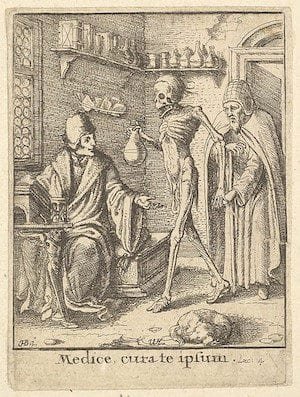
Treating Your Own Kids
Sometimes it’s your own kids with the complaints – they wake up in the middle of the night puking, or with a fever, or with an asthma attack. In the case of Rogue Two, last month he had all three at once.
It seemed to be his “typical” asthma, being trigged by a virus. We dutifully followed his asthma action plan (from his pulmonologist). During the day I examined him (I keep a stethoscope and otoscope at home), and finding nothing concerning, we decided to give it time.
When my kids have a non-emergent illness that’s clearly within my regular work as a physician, I often do the initial evaluation, and occasionally prescription (regular antibiotic, steroid for croup, etc) on my own. Essentially if it’s something that shouldn’t require a test or procedure or consultant (or obviously a hospital stay), I take care of it myself and update their pediatrician about it later if necessary.
On the 5th day of waiting it out — still with fever and a persistent cough, now with rigors in bed at night, enough was enough. While he looked fine when the fever decreased, 5 straight days was a tipping point (5 days of fever is a magical number for those of us in pediatrics, though Kawasaki’s Disease was not on my differential).
While he was hydrated and breathing comfortably (coughing is his main asthma symptom), we were concerned he may have something I hadn’t picked up. Or to be blunt — I was worried I was missing something, such as pneumonia.
I took him to his pediatrician. I made no suggestions — I gave the details of the illness, but I did say I wanted someone else to look at him to make sure I wasn’t missing something, given he had not improved as expected.
The pediatrician looked him over and essentially said the same thing — he looked and sounded fine. However she suggested a chest x-ray to check for pneumonia.
We deal with this situation in the ER on a routine basis. As the doctor, I am commonly advocating wait-and-see approaches. We had been doing that at home without improvement, so in this case I think the x-ray was justified, regardless of what it found. In some cases, more waiting may be appropriate.
As the parent, I was quite happy when the doctor suggested the x-ray, even if pneumonia was a low likelihood.
Therein lies the contradiction – when you take off the doctor hat and put on the parent hat, the perception of what your child needs can change dramatically.
As Dr. Dad, I wanted to examine the patient, consider potential diagnoses, devise a treatment plan that worked for the patient and which the family could follow, and counsel the family (myself and my wife) appropriately on what may or may not happen over the next few days.
As regular dad, I just wanted to make sure my son was okay, and I wanted someone else to do the thinking.*
*In a future post I plan to explore how having a children impacts my work as a pediatrician/peds ER doctor and as a dad. You do not have to have kids to be a good pediatrician, but it’s definitely made *me* a better doctor. I’m not sure that it’s made me a better (or worse) dad.
What’s the Diagnosis?
Below is the two-view chest x-ray we obtained.
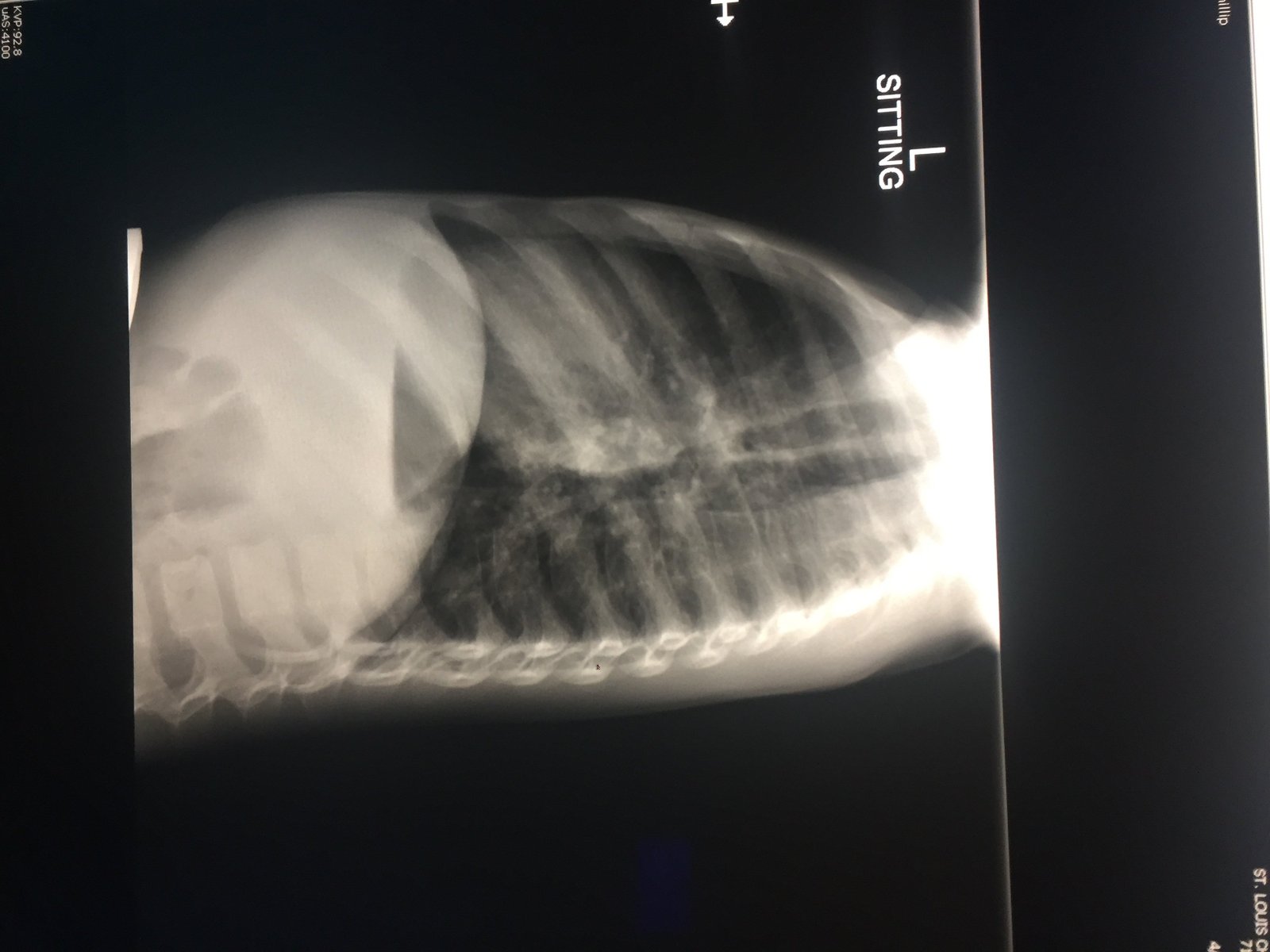
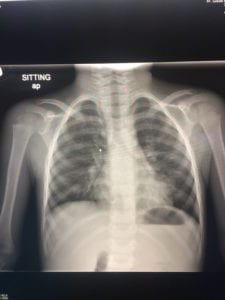
So what’s wrong with these pictures?
It’s subtle, and hard to tell with these images, but my interpretation (I looked at it on my own immediately), and that of the pediatric radiologist, was a possible early pneumonia along the left heart border (for the non-physicians — look at the picture on the right, and along the RIGHT side of the picture you’ll see some fuzziness along the border of the heart).
The pediatrician started him on antibiotics, and within 48 hours he was essentially symptom free.
Soft call? Possibly. It could have been a virus that ran its course in the timeframe we started the antibiotics. No way to know at this point.
Ground Rules for Treating Non-Patients as Patients
So what do you do if you are in a position of giving medical advice for someone who isn’t officially your patient?
You need to establish some ground rules — first and foremost, decide if you are even willing to consider it. Not everyone will.
If you are willing, then they are some obvious things to remember and some considerations. This list is NOT exhaustive, just a few common sense things:
- Do not practice outside your speciality. If you are an OB/GYN, do not give advice about treating chest pain, other than “go to the ER or call your doctor.” As an ER doctor (though focused on peds), I have exposure to a wide variety of illnesses/ailments (including “adult” things such as heart attacks), but there are MANY things I should not be doing. If you’re eligible for AARP, it’s possible I’m not the best person to ask for advice. I still know more on many topics than most lay people, so I share what I know, however I will not give concrete advice if it’s outside the scope of my peds/peds ER training.
- Remember liability — your workplace malpractice insurance is not going to cover you hanging a shingle outside your front door and starting a clinic in your garage. When I give medical advice to someone who isn’t a patient, I give enough caveats and/or cautions they likely think I don’t know what I am doing. Friends and neighbors can misinterpret advice, or they can follow good advice and have bad outcomes, just like a patient in your clinic/ER/hospital. They can sue you also. This has never happened to me, but I’m putting my livelihood on the line (and my family well being) every time I treat a patient, whether in the ER or in my living room — it’s a responsibility that should be taken seriously no matter the setting.
- Keep a record — if you are going to treat someone, consider a folder with paper to jot notes so you have a record of the conversation, just as you would do in your regular practice setting. I received this advice years ago and have never actually done this, but I probably should.
As I said, not an exhaustive list, just a few things that come to mind. Medical ethics are tricky and I take my obligations as a physician seriously. When in the ER, if I don’t know the appropriate next step, I call a consultant or send the patient somewhere else where they can get the answer. Ultimately I’m a person first and a doctor second, so I generally help people when they ask, occasionally going a bit outside my comfort zone to do so. However as with everything, know your limits.
What are your thoughts? How do you balance your work knowledge and personal relationships? As a reminder — nothing on this blog constitutes official medical or professional advice. Listen to me at your own peril.





Another great post. Our kids have been relatively healthy for the last couple of years, but their first few years in daycare had us going to the doctor about once per month. Would have been really handy to have an otoscope on hand (and the skill to know what we were looking at) back then.
Glad Rogue 2 is doing better and I hope Rogue 3 gets better real soon!
You wake up too early — how have you already had time to read this? Rogue 3 woke up at 530am bright-eyed and ready for the day; both his brothers were in our bed because of a thunderstorm. All seem to be doing well.
We’ve had our share of daycare associated illnesses, including when we thought Rogue 1 may have meningitis (turned out to be roseola). While I’m also incentivized to handle minor things on my own because of the high deductible health plan we’ve had the last few years, it’s mostly just the fact that I do this routinely that makes me comfortable with it. If I was a pediatric GI doctor who didn’t routinely deal wtih this stuff I may feel less comfortable doing it on my own for minor illnesses.
Not glad to see you have a high deductible. Always a bit shocked that man Drs and nurses don’t have very good or affordable plans.
We use to go to the same church as our Dr. We actually tried to not bug her at church and certainly not at home. At church, she just wanted to be herself not Dr. so and so. Only 1 in 17-years did we call her at home.
It is good you are able to use your training. Of course, it can be difficult to take the Dr hat off when you do need to go in.
My wife and I are coaches at a local high school. We ask the parents to be encouragers and to let us be the coaches. You miss too much if you as a parent are focused too much on performance and it sets up extra, unnecessary tension between them and their child and between them and us. So kudos to you for letting the other Dr. be the Dr.
BTW, I was up at 4:30, on the west coast, but a lot of what we do happens on the east coast so we’ve got to be up.
cd :O)
I don’t mean to cry poor over the HDHP — compared to ones on the open market, our deductible is VERY low ($3k) and the out of pocket max is also low ($5.5k I believe) — that’s almost as good as some people’s regular plans. My premiums are dirt cheap and we max out the HSA. We have regular plans available, but I crunched the numbers and it was a better deal to do the HDHP. Years we don’t use the insurance we have an extra $6k saved/invested in the HSA. Other times I still pay a lot of the costs out of pocket so I can leave the HSA money invested. At this point it’s like an extra emergency/investment fund to tap when needed (it’s still quite small as I have used some of it to offset expenses).
I am of mixed feelings regarding the advice — on one hand, I generally never talk about my work with most friends or family. On the other, I want to be of assistance when I can. I just want it to be on my own terms, which is hard to do. I ask friends for advice on things they do professionally that help me personally without always having to pay — I feel somewhat obligated to do the same for close friends/family as well. Sometimes the advice is go to see their regular doctor, but sometimes I can save them a lot of expense or time. That’s part of why I treat my own kids minor illnesses when I can — it saves money AND time. I have colleagues that keep Dermabond (surgical glue) at home for their kids — they will repair minor lacerations at home. They were surprised when they found out I didn’t last year, when Rogue One needed the glue for a small laceration. I am asked less at home now than I used to be — moved from the city and a small street with constant neighbor interaction to a suburb. We just don’t see neighbors as often (the biggest downside for me). Similar to you I think most people respect the boundary between friend and professional, but healthcare is so painful to access in this country that it’s hard to avoid. I wonder if places with universal healthcare have this issue.
430? You must be in finance, working with companies on Wall Street or something.
Yes, we are in the very “sexy” world of bank CDs. Of course, I also get to go home earlier than most so I have been afforded the opportunity to coach and attend my kids sporting functions, etc. So it has been a win.
My academic/ER schedule has given me flexibility to do a lot of activities with my kids that a lot of other doctors just don’t have. Also it fits my personality — I wouldn’t do well in a daily 9-5 job. I like variety in my schedule, though that does interfere with family life at times when I work weekends or evenings/nights.
What’s happening with CDs at 730AM on Wall Street? I’ve never bought one — the 1% interest rates I see advertised aren’t that appealing. 🙂
Well, Wall Street doesn’t have too much us for us either. But thankfully other “folks” do. :O)
As a radiologist, I like to play the “i’m not a real doctor” card when friends or family ask for prescriptions or advice about their illnesses. Sure, I’ll look at your MRI, but I haven’t written a prescription in over a decade.
My pediatrician wife, on the other hand, is frequently hounded for advice, and she is usually nice enough to help out, although she draws the line at writing prescriptions for non-patients. I feel a bit guilty that I mentally check out of doctor mode when our kid is sick, and just let the house pediatrician handle it.
Writing a Rx for a non patient is a good line. I’ve done that for my kids for minor illnesses (and my wife for things I am qualified to treat) or to get them refills on regular meds (ie asthma inhalers). I’ve never given a Rx to a non immediate family member. However I have a lot of doctors in my family, so they don’t need to ask me for a Rx if they need something. They only ask for ER-type advice. 🙂
You may not be a “real” doctor, but you can bet I want your advice when I am working in the ER. How many people bring you MRI’s to look at? That would make me way more nervous than treating an ear infection.
I probably look at an imaging study of a friend or family member every couple of months. It’s funny what makes us nervous; I am not at all skittish about giving my advice on imaging, but get very shifty when asked for “clinical” medical advice.
My wife will not let me forget the time on an airplane when they asked for a doctor, and I elbowed her to wake her up and go check things out.
Just remember: C-A-B. Clinical correlation advised prior to initiating compressions. 🙂
Like Dr. Curious, I get fewer of these questions because I’m not in primary care.
A surprising number of people don’t even know that an anesthesiologist is a medical doctor at all. I do field some questions from close friends and family, but I haven’t touched a prescription pad (or EHR equivalent) since I finished residency.
Glad to hear Rogue 2 is better after the antibiotics. We took our second son to the pediatrician’s office after a fever / cold of similar length in March. We were heading for Europe the following day and wanted to be sure we hadn’t missed anything at home (I, too, have an otoscope). Nothing was found — rapid strep test was negative — but it was worth the $120 to be assured we wouldn’t have to seek out a doctor on vacation.
Cheers!
-PoF
Wait — who writes the post-op pain med Rx’s? Is that all from the surgeons? Thinking to my own/kid surgeries I guess that’s probably the case. You must not have a pain medicine clinic. 🙂 $120 for a rapid strep — you must be on a HDHP also. I just got the facility fee for the CXR — was almost $300.
I think it’s interesting re: the perception of anesthesiologists. Maybe it’s because people have a hard time understanding what it is you do, and for many clinical interactions with you they are asleep.
The worst part is that my family asks me all sorts of internal medicine questions (yes I am board certified in IM but have not practiced it in many years). Then when it comes to a cardiology question, it is like I don’t exist. My aunt had a heart attack and never called me, but when she has a sinus infection I am the first on her list.
Craziness. I avoid treating my son. I have no idea what and how kids diseases work comparatively.
I am spared a lot of questions from my side of the family because we have several physicians (though mostly in peds). My wife side of family doesn’t have any physicians so I am sometimes asked questions that Google could probably answer better.
As a cardiologist, let me take this opportunity to ask you a question. Should all brown people (desi variety) be on statins? How do you interpret the MASALA trial?